Before approving a ring CAD, check the ring size, the actual stone dimensions, the setting height, the band profile and how the ring will sit beside any wedding band. Ask for more than one view and record your changes against a clearly identified version. You should understand what you are approving and which details still need the jeweller's assessment.
If you are planning bespoke jewellery in Dubai, this is a useful point to slow down and resolve uncertainty. You do not need to become a CAD designer. Your job is to explain how you want the ring to look and feel; the workshop should explain how the proposed design addresses those wishes and any practical limitations.
What is jewellery CAD, and what are you looking at?
CAD means computer-aided design. As GIA explains in its introduction to jewellery CAD/CAM, a three-dimensional model can be examined from different angles and revised before manufacture. Rendering software can also produce a realistic-looking image of that virtual design.
A rendered picture and a technical model serve different purposes. The picture helps you consider appearance; dimensions and written specifications help define the piece to be made. Ask whether the view you have received is an early concept, a design for your comments or the version intended for production approval.
A convincing image is not a photograph of the finished ring. It does not confirm the identity or grade of a diamond, establish the final surface finish or tell you how the ring feels on your hand. Keep the stone documentation and agreed material specification alongside the design, rather than expecting the image to communicate everything.
Request views that answer different questions
A single angled image can make a design easy to admire but difficult to assess. Request enough views to understand the parts you care about:
- From above: consider the centre stone's orientation, the outline of the ring and how the shoulders meet the setting.
- From the side: review the proposed setting height and the relationship between the stone, its support and the band.
- Along the finger: ask to see the band profile and the shape beneath the setting.
- Beside a companion band: if the rings will be worn together, review that relationship before approving either piece.
Ask the designer to label the important measurements. A ring enlarged to fill a phone screen gives little sense of scale. If you like the width or height of a ring you already wear, bring it to the discussion or provide measured references, rather than describing the new ring only as “delicate” or “substantial”.
A practical ring CAD approval checklist
| Check | Question to resolve |
|---|---|
| Ring size | Which sizing system and final size does the design use, and how has that size been confirmed? |
| Centre stone | Does the model use the selected stone's measured length, width and depth, or a temporary placeholder? |
| Setting height | Where is the height measured from, and what will the proposed profile mean for everyday wear? |
| Band shape | What are the intended finished width, thickness and inside profile? Which dimensions vary around the ring? |
| Stone support | How will the chosen stone be held, and which visible details will be completed or adjusted during setting? |
| Companion ring | Will the planned wedding band sit beside it as intended, with a deliberate gap or a shaped fit? |
| Materials and detail | Are the metal specification, finish, additional stones and any engraving recorded in the same approved brief? |
| Approval scope | Which version is approved, what happens next, and what remains conditional? |
Ask the jeweller to distinguish intended finished dimensions from dimensions used during manufacture. If something looks heavier than you expected, request an explanation of that specific feature. Do not approve solely because someone says every CAD looks bulky, or assume every visible difference will disappear during polishing.
There is no single band width or setting height that this guide can recommend for every ring. Stone dimensions, construction, material and intended wear all belong in the design discussion. A useful answer explains the proposed choice for your piece rather than giving a universal measurement.
Confirm the stone before treating its setting as settled
Ask whether the centre stone has been selected and measured. A description such as “one-carat pear” is not a complete setting specification. If the stone is still being sourced, identify which part of the design may need another review once the actual stone is available.
For a stone you already own, share the available documentation and ask what assessment is needed before it can be accepted for the project. Do not assume that a photograph alone confirms its suitability. If the stone changes after a CAD has been prepared, ask whether the setting and your approval need updating.
Our gemstone sourcing and setting page explains how to start that conversation. For the wider choice of pear outline, orientation and appearance, use the separate pear-shaped engagement-ring guide.
Make revision requests easy to understand
Collect your comments into one message and refer to the same dated set of views. Describe the feature, the change you want and the reason behind it. For example: “In the side view, I would like to explore a lower profile because I prefer a ring that sits closer to my finger. Please explain what that would change elsewhere.”
This is more useful than asking to make the whole ring smaller. It gives the designer a preference to assess without prescribing a technical solution. If a requested change affects another part of the ring, ask to review the complete revised design, not just a cropped view of the altered feature.
Before development starts, agree what the quotation includes for revisions and how additional work would be handled. Keep decisions in one place. An approval should identify the design version and agreed specification; an unresolved question should remain visible rather than being buried in a long message thread.
Would a physical sample help?
If your uncertainty concerns scale, fit or the relationship between two rings, ask whether a physical model or sample would answer it. Confirm its material, purpose, availability and terms for your project. A sample intended to show shape should not be treated as evidence of every property of the finished precious-metal piece.
For a remote consultation, explain that you cannot attend a fitting and ask what can reasonably be assessed through photographs, measured views or video. If you are visiting Dubai for a limited period, share those dates before agreeing the approval stages. Design review, manufacture and collection need an agreed sequence; a travel date is not itself a confirmed delivery commitment.
From CAD to a finished La Roche ring
These two images come from our documented pear-shaped solitaire project. One shows the CAD; the other shows the finished ring. They give a real reference for discussing a design across two stages of the same project.
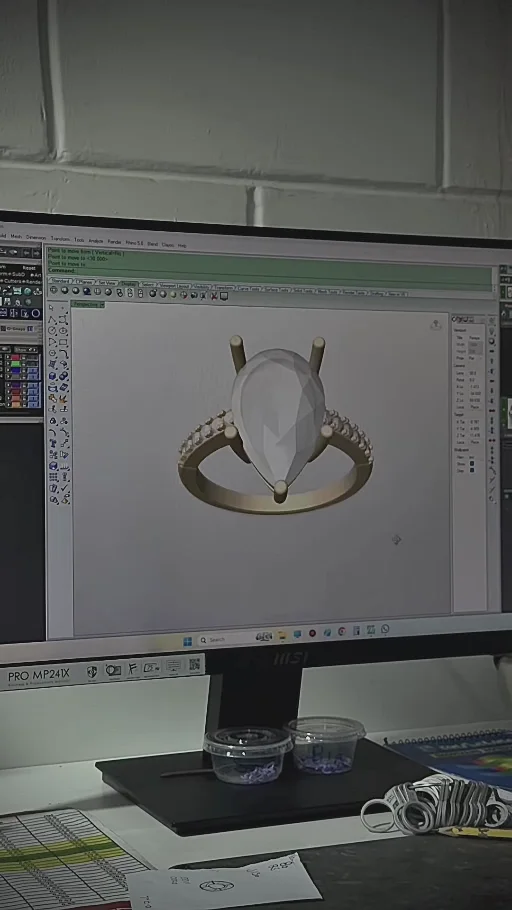
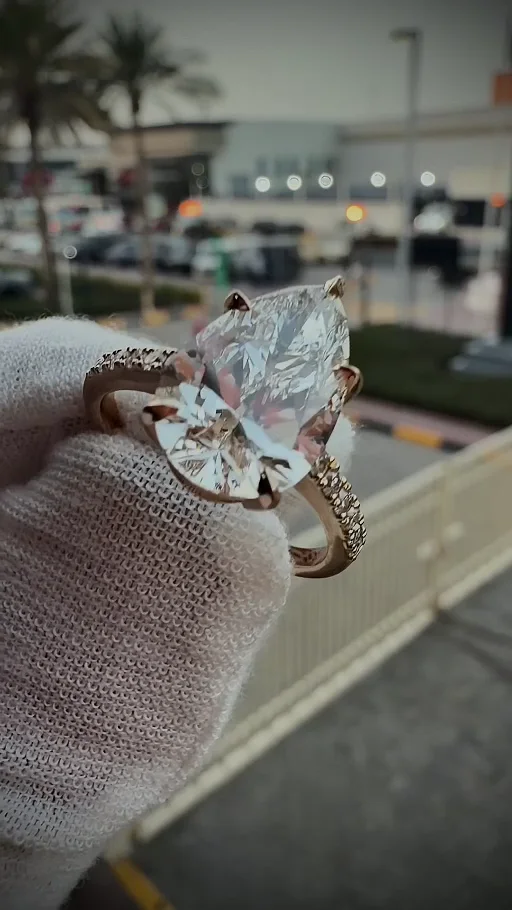
The case study and process film document CAD, filing, setting, polishing and the finished piece. Stone sourcing and casting were also part of the project, but were not filmed. The centre stone's identity, weight and grade, and the metal specification, are not published for this project.
This particular project was completed within two days at the customer's request. That result is not a standard turnaround promise. A new project's design, stone availability, approvals and production schedule must be reviewed before a completion date is confirmed.
For designers and brands: separate design approval from batch approval
If the ring is part of a collection, identify the design code and the exact version being reviewed. List sizes, stone options and other variations separately. Confirm whether approval applies to one sample or also authorises a production quantity; do not leave that distinction implicit.
Agree the required file deliverables, revision record and any sample approval before the next stage. File ownership, permitted use and reorder arrangements should be discussed for the project. Our jewellery CAD design and sampling service is the starting point for a trade development brief; the manufacturer-selection guide covers the wider production relationship.
Questions about approving a ring CAD
Can I start without a finished design?
Yes. A written idea, sketch or reference you have permission to use can start the discussion. Explain which features matter to you and which decisions need advice. You do not need to supply a production-ready model to enquire.
Does approving a CAD mean approving the diamond?
Do not assume so. Confirm the selected stone and its documentation separately, and make sure the design uses the correct dimensions. Ask the jeweller to state whether your approval covers design, stone selection, manufacture or a defined combination.
Will the finished ring look exactly like the render?
A render represents the proposed design. Treat the agreed dimensions, materials and details as the reference, and ask which features are illustrative or still subject to workshop finishing. Review the actual stone independently of its rendered appearance.
Can I make changes after approval?
Ask before authorising the next stage. The answer depends on what has begun and the change requested. Confirm any effect on scope, private quotation and timing rather than assuming another revision is included.
Do I receive the editable CAD file?
Confirm deliverables and file-use rights in the project agreement. Receiving a rendered view does not by itself establish that editable files or manufacturing rights are included.
Discuss the bespoke ring you want to create.
Send your references, stone details if available, ring size if known and occasion date. Tell us which design decisions you would like help with. La Roche will review the brief with you and discuss an individual private quotation.
Start a bespoke ring enquiryDeveloping a collection? Send a trade CAD and sampling brief.